Mojo Magazine December 1999.
(Transcript thanks to Natalie Lyons)
DANGER! DEMOLITION IN PROGRESS
Roger wanted Rick out. Dave thought Nick was next. Bob gave them the hit and got sacked too. Now, for the first time, all the architects of The Wall speak out on the project that destroyed Pink Floyd.
Sylvie Simmons dons her hardhat
The Cast:
Roger Waters - Writer, vocalist, bass-player, producer.
David Gilmour - Vocalist, guitarist, producer, co-writer (of Comfortably
Numb, Young Lust, Run Like Hell).
Rick Wright - Keyboard player, for the first half of The Wall as
a member then as a salaryman.
Nick Mason - Drummer.
James Guthrie - Engineer, co-producer.
Gerald Scarfe - Artist, animator.
Bob Ezrin - Producer (former clients: Alice Cooper, Kiss), co-writer
(of The Trial), aged 29 when The Wall began.
On June 16 this year Rick Wright finally did
what every therapist advises: confronted his Nemesis. "I think I’m the only
one who's actually seen Roger in the last 18 years. John Carin, who
was playing with Roger and was on the last two tours I'd done, said,
'Please come along.' I still had a lot of anger - I haven't spoken
to him since The Wall - but I thought, Oh shit, why not? I don't
have to see him. I was sitting in the audience signing autographs
while he performed on-stage. When he did Pink Floyd music it felt
very odd - that I wasn't up there, or Dave or Nick." When the
show was over Rick Wright decided to go backstage.
"It was a difficult one - for both of us. There are a lot of issues that
maybe one day we'll talk about but at the time I didn't want to go into all
that. I just said, Hello, how are you, you're looking well."
"He stood in front of me, grinning" says Roger Waters. "I think
he'd had a couple, there was a bit of Dutch courage going on, but he was perfectly
gracious. So was I, I think. He introduced me to his wife, I said hello, and
that was it. It wasn't uncomfortable. We didn't have much to say to one another." Wright
and Waters had known each other, played together, since the early '60s. Until
The Wall, when Roger threw him out of Pink Floyd.
The Wall is the concept album of concept albums, a multi-levelled
- lyrically, musically, visually - architectural structure, each
brick a scar on the psyche. Dark Side Of The Moon has been named
as the thinking man's favourite album to have sex and take drugs
to; the practical use of The Wall for the millions who made it a
Number 1 album (five weeks in Britain, 15 in the US) can only be
speculated. Bleak, claustrophobic, but with moments of flesh-tingling
beauty, its themes of paranoia, megalomania, betrayal, breakdown
and collapse appeared to permeate the people who made it.
It's The Wall’s 20th birthday this month - November 30, happy
birthday! - and as part of the celebrations there's a double live
album, produced by James Guthrie (also mixing the DVD of The Wall
film, which Waters found "terrible" but at least gave work
to the future Saint Bob) who right now has 110 reels of 2-inch tape
from three nights of concerts in 1980 and four in '81 baking in an
oven seriously; eight hours, gas mark 2. Apparently, the glue they
used to bind oxide to tape makes the reels go soft as they get older.
Something from which its musicians do not appear to suffer.
Since this first upsurge of as-near-as-dammit communal Waters-Gilmour-Mason-Wright
activity in the best part of two decades, the web has been buzzing
with speculation of a thawing of tensions, a reunion; a millennium
show; the Pyramids. "Ugh," Roger Waters shudders. "The
idea of having to stay in this big bowl of porridge swimming around
- no, I'm going to get out, hose myself down, ah, that's better.
Now I can get on with my life. The idea of getting involved with
any of them again - and you can imagine, they're constantly trying
to get me to leap back into the porridge - even doing this live album,
the sleevenotes, it's brought back to me how crazy it all is. I don't
want anything to do with it or them." His distaste is palpable.
In a studio filled with racing car posters in King's Crown, London,
3,000 miles from Waters' Long Island home, his old friend Nick Mason's
manner is far less severe, though his own detached, good-natured
way just as dismissive. "Would you want to put 200 road crew
together to work on New Year's Eve? Everyone's seen Spinal Tap and
that wonderful reunion moment at the end. I suppose if I had a sort
of fantasy about it it would have happened for something like Live
Aid. There's obviously an enormous sense of mistrust or betrayal
or anger or whatever. I think one gets over it, but it would be quite
difficult to revisit the areas that made it so much fun in the beginning."
David Gilmour, urbane, very English, camouflaging his true feelings
in language - passives, convoluted double negatives - talks about
Waters blithely, almost warmly at times, like an old sparring partner. "Obviously
one sits and thinks about these things on occasion and I have thought,
what would it be like if we all stood together in a studio and said
'Shall we do something?' I don't see how that could possibly work
- We invited him if he wanted to come and play on Dark Side Of The
Moon at Earl's Court with us, but he politely said, No thank you.
I actually invited him to my 50th birthday party, to which he also
said, Thank you, no. I haven't made the hugest of efforts to draw
him back into our fold, but I have been unstintingly polite."
And in the house in Atlanta, Georgia, where he lives with his American
wife, Rick Wright still seems like a man in shock. Oddly enough the
most conciliatory of the four, his talk of injustice, betrayal and
ongoing therapy is accompanied by the sound of thumping hammers.
There are builders working away behind us. They're building, as it
happens, a wall.
The Foundations
July 6, 1977. On the last night of the Animals In The Flesh tour at Montreal's Olympic Stadium, Roger Waters spits at a fan.
Gilmour: I can remember not enjoying it much as a show. They'd just finished building this big stadium and the crane was still in there, they forgot to dismantle it and couldn't get it out. I was so unenamoured that I went out and sat on the mixing desk for the encore - that might have not contributed to Roger's mood. I think Roger was disgusted with himself really that he had let himself go sufficiently to spit at a fan.
Waters: I'm not sure I hit him.
Mason: Well, Roger is not exactly a man known for peace and love - But we were sympathetic, even if we didn't feel as passionately as he did - those stadium shows are very strange. When we're playing, we're watching the audience, the same way the audience is watching us, and all you can really see is those front rows and - I'm not saying they're all nutters, but what you tend to get, particularly if it's what's euphemistically called 'festival-seating' - ie no seats - is the people who are mad enough to be able to push their way to the front, the air-guitar players, the people who know all the words and rather sad ones who have been waiting all day and collapse just as the band comes on-stage.
Gilmour: Roger never liked touring anyway very much, he was always rather tense and irritable. He was disgusted with the business in many ways, as we all were. The big change came with the huge success of Dark Side Of The Moon - the audiences liked to "interact," shout a lot. Previous to then, even though we played large places, 10,000-seaters, you could hear a pin drop at appropriate moments. So it had been a shock - but four years on I was getting used to the idea that that's the way it had to be.
Waters: It just became more and more oppressive. Those places weren't built for music, they were built for sporting events, and it's not unnatural to experience a ritualisation of war, because that's all sport is. What was going through my mind - my whole body - was an enormous sense of frustration, a feeling of what are we all doing here, what's the point? And the answer that kept clanging back monotonously was: cash and ego. That's all it's about.
Ezrin: I met Roger through his then wife Carolyne, who once worked for me. On the Animals tour, they stopped in Toronto where I was living, and on the limousine ride out to the gig Roger told me about his feeling of alienation from the audience and his desire sometimes to put a wall between him and them. I recall saying flippantly, "Well why don't you?." A year, 18 months later I got a call asking me to come to his home to talk to him about the possibility of working together on this project called The Wall.
The Master Builder
The Animals tour over, the band goes their separate ways - Gilmour and Wright to make solo albums, Roger to his house in the country to start writing.
Waters: Sometimes during
the day I'll get this very blank feeling - not an empty feeling,
it's very full - and I'll realise suddenly that I'm really long-sighted,
everything becomes very out-of-focus, and I think, "Oh, I'm going to write a song." Then
one has to take it by the scruff of the neck and use whatever craft
I've developed over the years to finish it off, but the initial creation
is a passive act. My view is it may be an expression of what Jung
describes as the collective unconscious - human beings seem to have
this need to illuminate and express their relationship with everything
else. I'm trying to think whether I'd had any psychotherapy at that
point and I think the answer is no, that didn't come until later
- 1981, I think.
Initially, I had two images - of building a wall across the stage,
and of the sado-masochistic relationship between audience and band,
the idea of an audience being bombed and the ones being blown to
pieces applauding the loudest because they're the centre of the action,
even as victims. There is something macabre and a bit worrying about
that relationship - that we will provide a PA system so loud that
it can damage you and that you will fight to sit right in front of
it so you can be damaged as much as possible - which is where the
idea of Pink metamorphosed into a Nazi demagogue began to generate
from.
(The theme of insanity) has something to do with Syd, but with my
own experiences as well. "When I was a child I had a fever,
my hands felt just like two balloons" is about the indescribable
feeling in my body during a high-fever delirium where everything
felt too big. On the couple of occasions in my life where I have
felt myself approaching metal breakdown it has felt like delirium,
so my connection with how Syd or other schizophrenics must feel is
taken from both that childhood memory and the odd moments on my life
of great personal stress when I have experienced the edges of that
same feeling...
Ezrin: Roger invited me down for the weekend - he had a lovely house in the country with an appropriately dark studio area. It was one of those wonderfully moody, grey fall weekends in England. He sat me in a room and proceeded to play me a tape of music all strung together, almost like one song 90 minutes long, called The Wall, then some bits and bobs of other ideas that he hoped to incorporate in some way, which never made it to the album but resurfaced later on some of his solo work. The English countryside under the weight of humidity and cloud was the perfect setting for this music and I was transported. It wasn't complete, it wasn't in anything like the final form of the work, but it captured the atmosphere and I just knew after listening to it that it was going to be an important work - and that it was going to take a lot of work to pull it into something cohesive.
Waters: I could see it was going to be a long and
complex process and I needed a collaborator who I could talk to about
it. Because there's nobody in the band that you can talk to about
any of this stuff - Dave's just not interested, Rick was pretty closed
down at that point, and Nick would be happy to listen because we
were pretty close at the time but he's still more interested in his
racing cars. I needed somebody like Ezrin who was musically and intellectually
in a more similar place to where I was.
Gilmour: We never made plans immediately after finishing a
project to get together and start the next thing, we always took a little bit
of time off. I'd been persuaded by a couple of old friends that I'd been in
a band with pre-Pink Floyd that we should just go in and make an album off
the cuff, and have a bit of fun. Rick was doing an album. When we did meet
up again in a studio in London, Roger had the idea that he wanted to make one
of two projects that he had been working on at his home studio during that
time. He came in with two fairly well-formed, largely demoed ideas: one was
The Wall and one was what eventually became his first solo album, which had
one very nice tune but in my memory it was too much the same. Between us we
decided The Wall would be the one we would start working on when we reconvened
in September.
Wright: At that time we were, in theory, bankrupt. Our accountants had lost our money, we owed huge amounts of tax, and we were told me must go away for a year, make an album to try and repay the tax we owed, so it was a pretty scary time for us all.
Mason: The tapes were very poor quality - Roger always made dreadful demos even though they were made on very sophisticated equipment - but it was immediately clear that it was an interesting idea that could be developed musically.
Wright: But there were some things about it where I thought, "Oh no, here we go again - it's all about the war, about his mother, about his father being lost." I'd hoped he could get through all of this and eventually he could deal with other stuff, but he had a fixation... Every song was written in the same tempo, same key, same everything. Possibly if we were not in this financial situation we might have said, "Well, we don't like these songs," and things might have been different. But Roger had this material, Dave and I didn't have any, so we'll do it.
Gilmour: It is true that we had some financial crisis, but I don't think that happened until after we'd started putting together the first bit of 'The Wall' at Britannia Row studios between September and Christmas. I thought it was a very good concept at the time - I don't like it quite as much now, with the benefit of hindsight I found it a bit whingeing - and well worth exploring. I was willing - have been before and since - to let Roger have full rein of his vision.
Brick By Brick: The Building Process
In an all-night session, Bob Ezrin ploughed through Roger Waters' tapes.
Ezrin: What I did that night was write a script for an imaginary Wall movie - as distinct from the film; I had nothing to do with that and was actually opposed to the idea of codifying it in any fixed imagery. I just had this sense of a narrative sound-scape - saw it, more than heard it - and organised all the pieces of music we had and some we didn't, plus sound effects and cross-fades, into a cohesive tale. I felt who the central character was and I came to the conclusion that we needed to take it out of the literal first-person and put it in the figurative - resurrecting old Pink to whom they had referred in the past. I came in the next day with a script - which, by the way, is in the Rock and Roll Hall of Fame - handed it out to everybody and we did a table-read of The Wall. It was a whole other way of doing things when you're making music, but it really helped to crystallise the work. From that point on we were no longer fishing, we were building to a plan.
Waters: The basic shape of it didn't change. Some songs changed a lot, others - Don't Leave Me Now, Is There Anybody Out There?, Mother - are almost exactly as they were originally.
Ezrin: Once we got out of Roger's house and into the studio, it was very much a collaborative effort, everybody had their opinions and contributions. It got very exciting sometimes. Often we'd have these bash-em-up's where we'd get into furious arguments about an approach to a song that would go on for weeks - as they're English and I'm Canadian we were very gentlemanly about it, but no-one would budge. But the conclusion when there was that kind of conflict - the synthesis of two opposing ideas - was very much stronger than the original idea itself.
Waters: I seem to remember the four of us in the beginning before the recording going through the demo and throwing stuff out.
Gilmour: Just sitting around and bickering, frankly. Someone would say, "I don't like that one very much," someone else might agree, and then Roger would look all sulky and the next day he'd come back in with something brilliant. He was pretty good about that during The Wall - he became less good during The Final Cut. Some of the songs - I remember Nobody Home - came along when we well into the thing and he'd gone off in a sulk the night before and come in the next day with something fantastic. It's often good to be geed up into a little state of rage.
Waters: They would like to believe, for whatever reasons, that the making of The Wall was a group collaboration - well, OK, they collaborated in it, but they were not collaborators. This was not a co-operative. It was in no sense a democratic process. If somebody had a good idea I would accept it and maybe use it, in the same sense that if someone writes and directs a movie he will often listen to what the actors have to say. It sounds to me a bit like Animal Farm, the pig fight about who was more equal than others. Since the break-up they've been at great pains to point out how it wasn't really my work at all and we all did it together. Well that's bollocks. It's just not true, as anybody who's listened to what they've done since can see - the fact that they don't actually do it, they get other people to do it. It's so clear. The Wall I think is a terrific piece of work and I'm really proud of it. No, I'll go no further down there.
Mason: It really did feel like a band working on a record - maybe in a slightly dysfunctional way, but I think most bands are dysfunctional.
Waters: Rick didn't have any input at all, apart from playing the odd keyboard part, and Nick played the drums, with a little help from his friends. And Dave, yeah, Dave played the guitar and wrote the music for a couple of songs, but he didn't have any input into anything else really. We co-produced it, I think, Ezrin and myself - the collaboration with Ezrin was a pretty fertile one, his input was big - and Dave got a production credit - I'm sure he had something to do with the record production; he had very different ideas about that sort of thing. But there was really only one chief, and that was me.
Gilmour: Roger was obviously one of the main producers because it was his idea and he was very, very good about many things to do with production, like dynamics. I've always been one of the producers on Pink Floyd records, and while I might not argue with Roger much over lyrics I think I know as much as anyone in or around the band about music and would certainly give my opinions quite forcibly. Bob Ezrin was in there partly as a man in the middle to help smooth the flow between Roger and I, whose arguments were numerous and heated.
Mason: We were looking at the way we worked to see if we could improve it, and everybody thought it would be enormously helpful to have an outside influence. Roger had met Bob Ezrin, and it seemed a good idea to have this hot young engineer, James Guthrie, to complement him.
Guthrie: At the time I got the phone call from the manager, Steve O' Rourke, summoning me to his office, I saw myself as a hot young producer! He told me the band were looking for some new blood and they'd heard my work - specifically The Movies and Runner - and sent me to meet Roger to see how the chemistry was between us. Basically, I wasn't told about Bob (Ezrin) and Bob wasn't told about me. When we arrived I think we felt we'd been booked to do the same job.
Ezrin There was an awful lot of confusion as to who was actually making this record when I first started. Titles notwithstanding, we were all very high-powered people, very specific in our approach to things, very opinionated and at the height of our careers creatively, so it was heady times - I think at that point Roger wanted the project to be his. But when one member in a band declares prominence over the others, it can make it difficult to work together and I think he was sensitive to that - or as sensitive as Roger can be - so he brought me in, I think, as an ally to help him manage this process through. As it turns out, my perception of my job was to be the advocate of the work itself and that very often meant disagreeing with Roger and other people and being a catalyst for them to get past whatever arguments might exist.
Wright: I really enjoyed the days of Dark Side... or Wish... when we might have been fighting but we were doing it together. I was concerned that an outside producer might lose what the four of us would do together. But on the other hand I thought "God, we do need a referee."
Waters: We were working shoulder-to-shoulder up to and including Dark Side... From that point on we weren't. We'd achieved what we set out to achieve together and the only reason we stayed together after that was through fear and avarice.
Gilmour: There's three sections of The Wall-making: first in Britannia Row in London, going through the stuff, having ideas, demoing it all up, then France, where we made the bulk of the album, and Los Angeles where we went to finish it up and mix it. In France, particularly, we worked very well, very hard. It's amazing how much we actually got done in a comparatively short time.
Mason: The pace was fast and furious, very focused. We were actually running two studios in France at once.
Gilmour: Superbear, the studio we were mostly at, was quite high in the mountains and it's rather notorious for being difficult to sing there, and Roger had a lot of difficulty singing in tune. He always did - ha ha. So we found another studio, Miraval, and Roger would go there with Bob to do vocals.
Ezrin: We were working to a deadline which was
a declared vacation - we had a lot of vacations! I once added it
up and I think the whole process probably came out to four or five
months of real studio time, but spread out over a year because we
did short hours and took a lot of vacations. They were all family
guys and wanted to work 10-6 - no, Roger decided we were working
10-6. We worked gentlemen's hours, wore gentlemen's clothes, ate
gentlemen's food, even had tea and biccies brought in every day at
the appropriate time. It was all very civilised. And considering
we were doing at the same time some fairly countercultural stuff,
it created almost a schizophrenic feeling of surreality about the
project - in France, even more so. Some of us were living in Nice,
some had rented entire towns, some were living at the studio, it
was all quite fragmented, but we would come together at the studio
and be creating these amazing things made out of some of the most
banal elements - drum sound effects were nothing more than roasting
pans being thrown at the floor.
I came in with a lot of ideas that were slightly foreign to the English
team. We pioneered the multiple machine approach to recording that
is now accepted as standard operating procedure. We cut our basic
tracks on a 16-track, copied them to a mixed-down version on a 24-track,
took all the drums and bounced them down to just a few tracks, put
them on the 24, then added all of our overdubs, instruments, sound
effects, vocals. The plan at the end was to sync up the 16- and the
24-track so they would run together, and the instruments on the 16-
would come back sounding absolutely glorious, because the tapes had
been stored and not played and worn-out over all the months we'd
been working, then all the overdubs would slot on top of them and
we would have this wonderful-sounding album. It sounded a bit like
witchcraft to everybody when I proposed it. To their credit, they
embraced the concept, but as we got closer to the moment of truth
they got more and more nervous. Guthrie in particular. I remember
as we were finishing up one song it was necessary to erase the copy-drums
from the 24-track, which meant that if the two tapes didn't sync
up there would be no drums at all. James blanched when I made him
press the erase button; it was like asking him to shoot a child.
When it worked, you've never seen such a look of relief on the faces
of so many people. That process has a tremendous amount to do with
why that album has got that incredible presence and such a density
of sound.
Two Songs:
Comfortably Numb
Guthrie: Everyone - including Roger - was encouraging
Dave to come up with some ideas, and the day he turned up with
Comfortably Numb, sang a la-la melody over the top of these chords,
was fantastic.
Gilmour: Roger and I had a good working relationship. We argued a lot, sometimes heatedly - artistic disagreements, not an ego thing. I don't think we argued over who would take lead vocals, Roger was not over-bothered who sang - but overall we were still achieving things that were valid. Things like Comfortably Numb are really the last embers of Roger and my ability to work collaboratively together - my music, his words. I had the basic part of the music done. I gave Roger the bits of music, he wrote some words, he came in and said, "I want to sing this line here, can we extend this by so many bars so I can do that," so I said, "OK, I'll put something in there."
Waters: Karl Dallas wrote a book some years ago that infuriated me because he said it was Dave who wrote one of the compelling songs on the thing, Comfortably Numb. That's just not true... What happened is Dave gave me a chord sequence, so if you wanted to fight about it - and I don't want to fight about it - I could say that I wrote the melody, and all the lyrics, obviously. I think in the choruses he actually hummed a bit of the melody, but in the verses he certainly didn't. That's never been a problem for me, I think it's a great chord sequence. Why are we talking about this? Arguing about who did what at this point is kind of futile.
Ezrin: Comfortably Numb started off as a demo of Dave's - a piece in D with a lovely, soaring chorus and a very moody verse. At first Roger had not planned to include any of Dave's material but we had things that needed filling in. I fought for this song and insisted that Roger work on it. My recollection is that he did so grudgingly, but he did it. He came back with this spoken-word verse and a lyric in the chorus that to me still stands out as one of the greatest ever written. The marriage of that lyric and Dave's melodies and emotionally spectacular guitar solo - every time I hear that song I get goosebumps.
Gilmour: We went to LA with two versions of it - we recorded one backing track, just the drums basically, which Roger and Bob liked a lot but I felt was a bit loose in places so we did another take which I liked better - and we had quite a large row about which of these two versions we should use. In the end, we used bits of both, and I'm not at all sure if you played me one of those backing tracks and then the other one I'd know the difference now, but it seemed incredibly important at the time. You can divide Comfortably Numb into dark and light - the bits I sing, "when I was a child..." are the light, the "hello is there anybody in there" that Roger sings are the dark - and on the dark stiff I wanted to have a bit more of the grungey guitar element, while Roger and Bob wanted it just drums and bass and orchestra. We argued vociferously about that and I lost on that occasion, and I still feel I was right. On-stage I would always add the grungier tone.
Another Brick In The Wall Part II
Waters: On the demo I made it was just me singing
to an acoustic guitar.
Gilmour: It wasn't my idea to do disco music, it was Bob's. He said to me, "Go to a couple of clubs and listen to what's happening with disco music," so I forced myself out and listened to loud, four-to-the-bar bass drums and stuff and thought, "Gawd awful!" Then we went back and tried to turn one of the Another Brick In The Wall parts into one of those so it would be catchy. We did the same exercise on Run Like Hell.
Ezrin: I'd just done a session in New York and Nile Rodgers and Bernard Edwards were in the next studio. I heard this drum beat and went "Wow, would that ever work great with rock 'n' roll!" When I got to England a few months later and I started listening to Another Brick..., that beat kept playing through my head.
Mason: I don't remember anyone complaining. There is a standard speed for a disco track and we followed that to the letter. It was recorded in a very disco way - drums and bass put down on their own and everything added gradually on top.
Ezrin: The most important
thing I did for the song was insist it be more than just one verse
and one chorus long, which it was when Roger wrote it. When we
played with the disco beat I said, "Man, this is a hit! But it's one minute 20, it's not
going to play. We need two verses and two choruses." And they
said, "Well you're not bloody getting them. We don't do singles,
so fuck you." So I said, "OK fine," and they left.
And because of our two machine set-up, while they weren't around
we were able to copy the first verse and chorus, take one of the
drum fills, put them in between and extend the chorus.
Then the question is, what do you do with the second verse, which
is the same? And, having been the guy who made School's Out, I've
got this thing about kids on a record and it is about kids after
all. So while we were in America, we sent Nick Griffiths to a school
near to the Floyd studios (in Islington). I said, I want Cockney,
I want posh, fill 'em up" - and I put them on the song. I called
Roger into the room, and when the kids came in on the second verse
there was a total softening of his face and you just knew that he
knew it was going to be an important record.
Waters: It was great - exactly the thing I expected from a collaborator.
Gilmour: And it doesn't in the end not sound like Pink Floyd.
The Fall-Out
The atmosphere in the various studios ranged from "tension" to "all-out war." It reached its nadir with the firing of Wright.
Ezrin: There was tension between the band members, even tension between the wives of the band members. There was a period in France where it was very hostile, that passive-aggressive English-style conflict.
Mason: Bob probably sees it as war because he was under attack. He was going through what can only be described as an unreliable phase of his life - he was staying down in Nice, we were all up in the hills, and he'd drive down there when he finished work and I suspect have a wild time and then be astonished when we were pissed off when he'd arrive back the next morning late.
Ezrin: Roger and I were having a particularly difficult time. During the period I went a little mad and really dreaded going in to face the tension, so I would find any excuse to come in late the next morning. I preferred not to be there while Roger was there.
Waters: There was certainly tension involved, but my feeling as I got up in the morning and climbed in the car in France to go off to work was a good, positive feeling, eager to get to the studio. Obviously, we were having problems with Rick - he was sort of there but not there.
Gilmour: Most of the arguments came from artistic disagreements. It wasn't total war, though there were bad vibes - certainly towards Rick, because he didn't seem to be pulling his weight.
Wright: I wanted to work, but Roger was making it very difficult for that to happen. I think he was already thinking of trying to get rid of me.
Ezrin: I saw it happening and it really made me quite ill. I felt that so much pressure was being put on Rick that it was virtually impossible for him to live up to expectations. It was almost as though he was being set up to fail. Under the circumstances I don't see how anybody could have survived
Waters: Why did I fire Rick?
Because he was not prepared to cooperate in making the record.
(Wearily) What actually happened was The Wall was the first album
where we didn't divide the production credit between everybody
in the band. At the beginning of the process, when I said I was
going to bring Bob Ezrin in and he was going to get paid, I said, "I'm going to produce the
record as well, so is Dave, so we're going to get paid as well, but
Nick, you don't actually do any record production, and Rick, neither
do you. So you're not going to get paid." Nick said fair enough,
but Rick said, "No, I produce the records just as much as you
do." So we agreed we would start making the record and we would
see. But who would be the arbiter? We all agreed on Ezrin.
So Rick sat in the studio -he would arrive exactly on time, which
was very unusual, and stay to the bitter end every night. One day
Ezrin said to me - he was slightly irked by this brooding presence
very occasionally going "I don't like that" - "Why's
Rick here again?" I said, "Don't you get it? He's putting
in the time to prove he's a record producer. You talk to him about
it." So he did. After that Rick never came to another session,
unless he was directly asked to do keyboard tracks. And he became
almost incapable of playing any keyboards anyway. It was a nightmare.
I think that was the beginning of the end.
But in the end of the end, since you ask, we had agreed to deliver
the album at the beginning of October and we took a break in August
to go on holiday. I sat down with a bunch of sheet music and paper
and wrote out all the songs and what was needed and made up a schedule,
and it became clear to me that we couldn't get it finished in the
time available. So I called Ezrin, "Would you be prepared to
start a week earlier on the keyboard parts with Rick in Los Angeles?" Eventually
he went, "All right. Thanks, pal," -because of the idea
of doing keyboard tracks with Rick. I said, "Look, you can get
another keyboard player in as well in case it's stuff he can't handle,
but if you get all that keyboard overdubbing done before the rest
of us arrive we can just about make the end of the schedule."
A couple of days later I got a call from O'Rourke. I said, "Did
you speak to Rick?" "Yeah. He said, 'Tell Roger to fuck
off.'" Right, that's it. Here I was doing all this work and
Rick had been doing nothing for months and I got "Fuck off." I
spoke to Dave and Nick and said, "I can't work with this guy,
he's impossible," and they both went, "Yeah, he is."
Anyway, it was agreed by everybody. In order not to get a long drawn-out
thing I made the suggestion that O'Rourke gave to Rick: either you
can have a long battle or you can agree to this, and the 'this' was
you finish making the album, keep your full share of the album, but
at the end of it you leave quietly. Rick agreed. So the idea of the
big bad Roger suddenly getting rid of Rick for no reason at all on
his own is nonsense.
Gilmour: (Sigh) I did not go along with it. I went out to dinner with Rick after Roger had said this to him and said if he wanted to stay in the band I would support him in that. I did point out to Rick that he hadn't contributed anything of any value whatsoever to the album and that I was not over-happy with him myself - he did very very little; an awful lot of the keyboard parts are done by me, Roger, Bob Ezrin, Michael Kamen, Freddie Mandell - but his position in the band to me was sacrosanct. My view, then and now is, if people didn't like the way it was going it was their option to leave. I didn't consider that it was their option to throw people out.
Waters: I had a meeting with Dave in my garden in the South of France at which Dave said, "Let's get rid of Nick too." I bet he doesn't remember that. How inconvenient would that be? I went "Ooh, Dave, Nick's my friend. Steady!"
Mason: I think in real terms it would be highly
likely that I would have been next. And then after that I think it
would have been Dave. That's what's curious when we talk about it
now. I think it's just that Roger was feeling more and more that
this was his idea and he wanted total control. Roger and I have been
friends since we were students, before the band even existed, so
I suppose in that way my position was stronger.
But what I think had been the case is there had always been a sort
of philosophical division within the band: Roger and I were seen
as the ones who liked the special effects, the show, the technology,
the non-music in a way, whereas Dave and Rick took a more musically
pure position. That's a very broad generalisation, but since this
was conceived from the beginning as a big theatrical production,
I think that's where the conflict started - because Rick is absolutely
not someone you would have a fight with, he's extremely mild. He
was his own worse enemy in that he could have perhaps given a little
bit more and maybe defused the situation, but I think Roger manoeuvred
brilliantly (laughs). Made Stalin look like an old muddle-head. We
all felt fairly hopeless at the time to change it or do anything.
Roger made it fairly clear that if Rick stayed, he and the album
would not, and I think the threat of what was hanging over us in
terms of financial - not just losses but actual bankruptcy - was
pretty alarming. We were under a lot of pressure. I felt guilty.
Still do really. In retrospect one likes to think that one would
have behaved better and done things differently. But probably we
would have done completely the same thing.
Wright: It would have been quite easy to say, "Oh he left because he had a cocaine problem or a drink problem." I can honestly say that it really was not a drug problem. It was taken without a doubt by him, me, Dave, Nick, Bob Ezrin, but purely socially, it wasn't lying around in the studio.
Waters: There were people who were doing a lot - some of us had big, big problems. I certainly wasn't doing drugs at that point.
Wright: When I think about,
right from the beginning Roger and I were never the best of friends,
but we weren't enemies either until he went into his ego trip.
Once he decided he wanted to control everything, his first step
was, "I'll get rid of
Rick, I've never like him anyway." It was part of his big game
plan to become the leader, the writer, the producer and have people
play for him. I think the next step of his plan, though they were
buddies, was to get rid of Nick, that's what I've heard, and then
Dave become the guitarist and use session musicians. You may think
that's all rubbish, but I suspect that's how he was thinking.
I think he would tell you that I'd lost interest in the band -there
are times around Animals where I would sit down with our manager
and say, "I've got to leave this band, I can't stand the way
Roger's being," but I wasn't really serious about leaving, though
sometimes I wasn't happy. At the time I was going through a divorce,
I wasn't that keen on The Wall anyway, and I didn't have any material.
He might have seen my situation as not having contributed everything
but he wouldn't allow me to contribute anything.
We had a break after we finished recording in France and I went to
Greece to see my family. I get a call from Steve saying, "Come
to LA immediately, Roger wants you to start recording keyboard tracks." I
said, "I haven't seen my young kids for months and months, I'll
come on the agreed date. " He said, "Fair enough, I understand." Come
the agreed day, Steve met me and said, "Roger wants you out
of the band."
Mason: He just took it and left. I think there must have been an element of him that just thought, "Well I've had enough anyway if it's going to be like this."
Wright: I fought my corner.
Dave and Nick would say, "This is not right, we think it's unfair”. When
we had the meeting Roger said, “Look, either you leave or I'm
not going to let you record my material for The Wall”. It was
maybe a game of bluff but that's what he said to me. Remember we
were in a terrible financial situation and he said to me, "You
can get your full royalties for the album but you can basically leave
now and we'll get a keyboard player to finish it." And I spent
many days and sleepless nights thinking about his whole thing.
I could have called his bluff and said, "OK, go and do a solo
album," and I think Roger would have then said, "OK, I'm
scrapping all this material" - it was his, so he had the right
to do that. I thought about it and thought about it and I decided
I can't work with this guy any more whatever happens, I was terrified
of the financial situation and I felt the whole band was falling
apart anyway. I didn't know, and I think I'll never know 'til the
day I die, what would have happened if I'd said, "No, I'm not
going to go." So, I made the decision, rightly or wrongly, to
leave. But I also made the decision I'm going to finish recording
this album and I want to be in the live shows and then we'll say
goodbye.
The interesting thing about all that is why, if Roger thought I couldn't
perform, why he then said, "OK, that's fine, you can finish
recording and do the live shows." It's very weird and bizarre,
and it was a time in my personal life - I would say I was confused.
Guthrie: Rick did some great playing on that album, whether or not people remember it - some fantastic Hammond parts.
Wright: My therapist is convinced I'm still extremely angry about the whole thing and in a sense I am. I think it was nasty. This is my band as much as it's his. But the fact that Dave and Nick and Roger fell out immediately afterwards - they did The Final Cut, but that was ridiculous as I understand it, they virtually had physical fights in the studio, Dave refused to have his name on the credits - kind of helped me deal with the fact that I'd left the band. But I don't like the way it was done - after 18 years I still feel it was wrong. Hopefully one day I'll sit down with Roger and he might then say, "yes, it was unfair."
Waters: No. It was absolutely the right thing to do.
The Wall
The album was completed in Los Angeles, its cover designed by Gerald Scarfe and Roger Waters. The sleevenotes to the original vinyl release credited three producers, one co-producer, four engineers, three writers, two orchestra arrangers, six backing vocalists, a sound equipment man and Islington Green School. The names Rick Wright and Nick Mason are nowhere to be seen.
Wright: I'd forgotten about that - Nick was left off as well? I wonder why now, but at the time I'd left the band and sort of given up.
Mason: I wasn't too happy. It was rectified on later pressings, I think.
Scarfe: I think Roger had a strong idea what The Wall cover should look like - completely white with the bricks on it. I did a little rough drawing one evening while we were staying together in France that had all the little characters inside that I'd designed for The Trial poking out of the wall.
Gilmour: Storm (Thorgerson) had already been pushed out a little bit by then. Roger was very displeased with him - these are very old stories and I can't claim to remember every detail but I think it culminated in Hipgnosis putting Animals into a book of album covers and saying it was theirs and didn't put in that it was from an idea by Roger. Roger's keen quest for credit on everything at the time made him rather upset.
Mason: There were a number of playbacks. One of the executives from CBS was absolutely appalled - went back and said, "This is terrible, rubbish, what are we going to do?" Of course, it all turned out fine.
Guthrie: Unlike most bands who have to answer to the record company, with the Pink Floyd, it's more, "We're going to make an album now, you'll hear it when it's finished." The official playback was at CBS Records in Century City. I went in a couple of hours early with a quarter-inch tape to set up the sound system in their conference room. By the time we got to the bit where the stukas swooped down, it was so loud it blew the right speaker, so we hunted the entire building for an office that was big enough and had a sound system that was even halfway decent. We eventually found one and took all the furniture out, threw in a load of cushions, turned the lights off and just played the album.
Wright: The playback was a very difficult, strange time. I think I was emotionally numb.
Gilmour: It was a magical moment: "Yep, we've pretty well nailed it."
Waters: A great, classic piece of work.
On With The Show
Pink Floyd's biggest spectacular yet: 45 tons of equipment, 106 decibels of quadraphonic sound, a bomber plane, inflatables, Gerald Scarfe's monstrous puppets, a fake Pink Floyd band in masks and 340 bricks erected by concealed hydraulic lifts into a 160x35ft wall.
Ezrin: We had rough-mixed everything in France, pulled it together in sequence, had a table with a model of the stage and teeny rubber men and mock-inflatables, and we played the record while playing the show on the table top, so the first time the band heard The Wall was a complete audio-visual experience. We were not just making an album, we were also building the stage show from the script. Roger and I would start our day at 8.30 in the morning at Gerald Scarfe's house looking at animation and then we would talk to Mark Fisher, architect designer extraordinaire, about the stage design. We spent a lot of time weighing bricks and making sure that if they fell forwards nobody would get killed. At that point we were even thinking of designing our own venue to take on the road this surreal tent in the shape of a worm.
Waters: The other guys in
the band had nothing to do with the show - they like to think they
did but they didn't. If you read the programme of the show it says
on the inside page, "The
Wall, written and performed by Roger Waters, performed by Pink Floyd," and
that's what it was. I was no longer interested in working in committee
with anybody.
I started working with Gerald to see what kind of ideas he came up
with. Probably out of his ideas for the animation came the idea,
hey, perhaps this could be a movie at some point. The original scripts
I started to write were about a story happening around a rock 'n'
roll show with us performing and bombing the audience - a strange,
surreal thing - and it wasn't until (director) Alan Parker eventually
became involved that, much at his instigation, we dropped the idea
of using any live footage of the band performing the piece and adopted
the idea that it should become a straight-forward narrative.
Scarfe: I had previously done some things with
Wish You Were Here and I became very friendly with them all. When
Roger had written The Wall, he came to me and played the raw tapes
and said he wanted to make an album, a show and a film. He was completely
honest about where the whole thing had come from. A couple of beers
and he would ramble on, as we all do, about things that happened
to him that had upset him.
We seemed to get on well. I like Roger's sense of humour - he has
this rather acerbic sense of humour which I do too, a cynical view
of life, and he's extremely witty. We used to play a tremendous amount
of snooker together, it became almost fanatical - competitive, but
it wasn't played for enormous amounts of money. Roger won, mainly.
Roger is one of those wonderful people as far as I was concerned
who seems to understand that when you hire an artist you hire what
the artist does, you don't tell them what to do. Obviously, you have
discussions, but it was up to me as to how I illustrated it. The
idea of using inflatables was something they had devised earlier,
but the designs were all mine.
First of all I had to decide what Pink would look like - I saw him
as this embryonic little prawn-like figure who was completely vulnerable,
because a lot of it is about how we hide behind a wall because we
don't want other people to hurt us. The wife I made like a serpent
that would strike and sting - I have no idea what his ex-wife looks
like so it was definitely not based on her. The teacher was based
vaguely on a teacher I'd known myself. That mother was an old-fashioned
'50's comforting type with these very strong arms that turned into
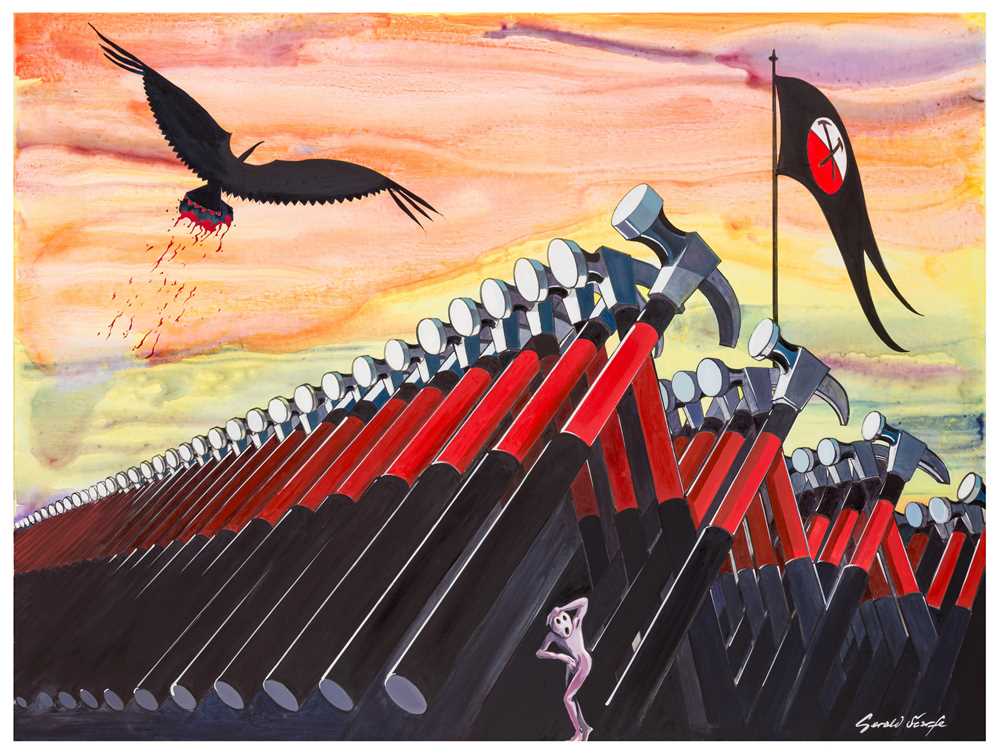
walls. The hammers came from me looking for a very cruel, unthinking
image, something intractable that couldn't be stopped, and then the
idea of them goose-stepping came from that.
It had humour to it, I hope, in parts, but it was generally pretty
bleak. I suppose the overall story is. Goodbye Blue Skies is one
on my favourite pieces of animation. For me that was very much a
hymn to the Second World War and the sadness of it all. I was a small
child during the war so I understood the feeling of bombers and gasmasks
- they used to make them for children in the shape of Mickey Mouse
because they were frightening, claustrophobic things to wear. I designed
some creatures called the Frightened Ones who had heads like gasmasks
and were running into air-raid shelters. Animation doesn't have to
be little Disney bunnies running around, it's unlimited, surreal.
I tried very hard with the open brief that all the guys in Pink Floyd
gave me - yes, I dealt mainly with Roger, but all the guys were completely
on my side - to give them my very best. Directing animation is a
very time-consuming thing, so it took over a year. An awful lot of
snooker.
Wright: As I saw it, Roger's original concept for the show was literally to build a wall, go home and leave the audience pissed off. But once that wall was built and the visual stuff put on it and the holes so that people could appear it became a very good theatrical device.
Gilmour: I suppose with things
like Spinal Tap coming out later with their wonderful "Stonehenge" -
but it all seemed to have a meaning and a point, and if mockery
was going to stop us it would have stopped us many years before
that. The shows were terrific. I enjoyed them thoroughly. As they
went along, through the 30-odd shows that we did, I became more
aware of the restriction imposed by something that was so choreographed
- there was not really much room for letting the music go away
into its own thing. But you just have to look on it as a different
thing - it's as much a theatrical piece as it is a musical piece.
I was in charge of all the mechanics of making it work. I had a six-foot-long
cue-sheet draped over my amplifier for the first few shows which
I had memorised after that, so I'd know exactly where a cue would
come from, because it could come from a floor monitor or from film,
and I had one control unit to adjust the digital delay lines on my
equipment and Roger's, Rick's and Snowy (White)'s, so I didn't really
notice what was going on around me terribly much.
Mason: The drums were in an armoured cage, so when the wall collapsed it wouldn't destroy them. It was a curious, rather nice environment - almost like being in a studio, except you're interacting, and odd, because it's half-live. Not much spontaneity, but we're not well-known for our duck-walking and general gyrating about on-stage.
Wright: Why did I agree to play? Maybe I couldn't actually handle the idea of just standing up in the room and saying, "Right, that's it, bye-bye." I thought, if I'm going to leave at least I know I've got another month or so to carry on working - even possibly with the hope in the back of my mind that things might change. On the live performances Roger was being reasonably friendly. It was difficult but I tried to forget all my grudges, and I enjoyed playing The Wall. I put everything I could into the performances, and I think Roger approved of that. We would talk civilly to each other. It wasn't too bad at all.
Mason: Of course it was. But the British are bloody good at that - just get on with it in spite of the fact that they're absolutely seething.
Waters: It was a 'fait accompli,' Rick was being paid a wage, he seemed happy with that, we were happy with that, and that was the end of it - or maybe he wasn't happy with it but it's not something we discussed. Backstage it was all pretty separatist - separate trailers, none facing each other - ha-ha - with all our little camps. The atmosphere was awful, but the job, the show, was so important that certainly on-stage I don't think that affected me at all.
Wright: It just seemed to me another example of why I'm not sad to leave, because the band had lost any feeling of communication and camaraderie by this time. But bands can go on-stage and perform music even if they hate each other. It was a band that I felt was falling to pieces - which of course it did.
Ezrin: I was asked to be involved with the show and I couldn't - I was going through a divorce and fighting for custody of my children. That and another incident, where in my naivety I took a phone call from a friend who happened to be a journalist and broke my non-disclosure with the band when he teased information out of me, so upset Roger, who was already feeling very nervous and was dealing with the Rick situation. That was it. I was banned from backstage. I went anyway, New York was sort of my territory, all the security at the venue knew me from Kiss and Alice Cooper. When the Pink Floyd security said, "He can't come in," they said, "Like hell he can't!" I had to buy my ticket, but saw the show. It was flawless and utterly overwhelming. In Comfortably Numb, when Dave played his solo from the top of the wall, I broke into tears. It was the embodiment of the entire experience. In the final analysis it produced what is arguably the best work of that decade, maybe one of the most important rock albums ever.
The Final Cut
In 1980-81 The Wall played in Los Angeles, New York, Dortmund and London, returning to Earl's Court to film footage ultimately not used in the movie. Then the band started work on The Final Cut.
Waters: I had complete control of The Final Cut.
Gilmour: That discussion came up on occasions. It wouldn't have been to the band's benefit for Roger to have total control, he wasn't up to it. He hasn't had huge success with anything over which he's had total control.
Waters: The concept (of The Wall's theme influencing its author's behaviour) is a convenient view for people. It's a short step from leader to dictator. We're all volunteers. Nobody had to stay. Even during The Final Cut, where everything finally exploded, I was always completely willing to make the record on my own. We'd been arguing since 1974, for God's sake. Too long. At a certain point you have to say, this is not working, the point has come to break up.
Gilmour: Roger said it was over. I said I would probably make another record. He made it clear he wouldn't make another record with us; I made it clear that it was my intention so to do.
Waters: I want people around me who are creative, lively, interested and interesting. Dave is none of those things. He doesn't have any ideas and he's not interested really in people who do, except insofar as they can write records that he can put his name on, which is what's been happening since I left.
Mason: I would never have imagined that we could have carried on without him until Dave said, "We can. Let's have a go." The feeling was, It's not your band to kill.
Waters: I didn't decide that the band would have to die. I expressed my view that that would have been the best thing. I would be distressed if Paul McCartney and Ringo Starr made records and went on the road calling themselves The Beatles. If John Lennon's not in it, it's sacrilegious. I don't want to put words into Dave's mouth but from what I've read I have a suspicion his view would be that a lot of people would hold the view that it wasn't OK to go on calling the band Pink Floyd when Syd ceased to function. The body of work that the four of us produced together post-Syd has some of that connection to the same things that The Beatles' work has a connection to, and that for me makes Pink Floyd important. And to continue with Gilmour and Mason, getting in a whole bunch of other people to write the material, seems to me an insult to the work that came before. And that's why I wanted the name to retire.
http://en.wikipedia.org/wiki/James_Guthrie_(record_producer)
http://www.geraldscarfe.com/
http://www.bobezrin.com/
http://www.spinaltapfan.com/
http://www.britanniarowstudios.co.uk/
http://www.rockhall.com/
http://en.wikipedia.org/wiki/Animal_Farm
http://www.studiomiraval.com/
http://www.amazon.com/Pink-Floyd-Bricks-Karl-Dallas/dp/1561711322
http://www.stufish.com/
http://en.wikipedia.org/wiki/Alan_Parker